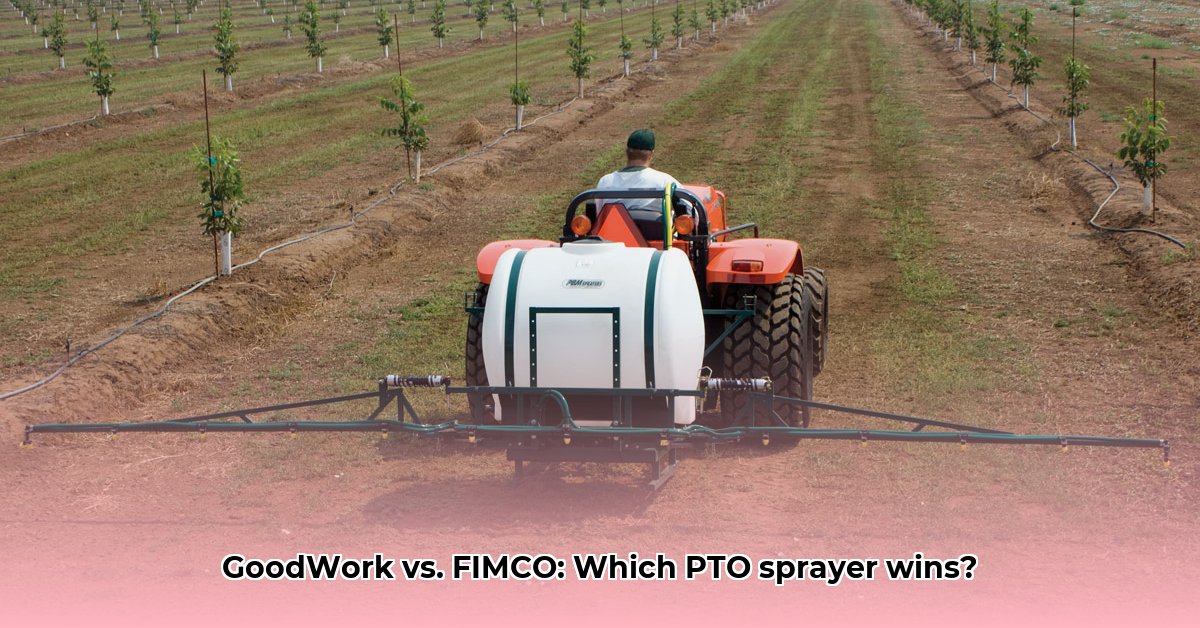
Choosing the right PTO sprayer is a crucial investment for any farmer. This comparative review analyzes two popular options – GoodWork and FIMCO – to help you select the best sprayer for your farm's specific needs and budget. We'll delve into key features, maintenance, and overall value, providing actionable advice to guide your decision. For more sprayer options, check out this helpful resource: Tractor Sprayers.
Capacity and Application: Matching Sprayer Size to Your Farm
One of the most significant differences between GoodWork and FIMCO PTO sprayers lies in their tank capacities. GoodWork offers a 90-gallon model, ideal for smaller farms or operations requiring precise spraying. This versatile model is suitable for boom spraying, boomless applications, and even spot spraying with a handheld wand. FIMCO, however, provides a much wider range, extending from 45 gallons to a substantial 300 gallons. Their larger capacity models are best suited for large farms needing to cover extensive areas quickly.
Is your farm characterized by large, open fields, or do you need maneuverability in smaller, more complex areas? This question will strongly influence your choice. A GoodWork sprayer is analogous to a nimble pickup truck—perfect for tight spaces. FIMCO, on the other hand, resembles a heavy-duty semi-trailer designed for vast distances and heavy loads.
Pump Technology: Power and Precision
GoodWork utilizes a robust 6-roller cast iron pump, delivering a powerful 9 gallons per minute (GPM). FIMCO, unfortunately, lacks readily available, detailed specifications regarding their pump technology across their product line. They offer both PTO (tractor-powered) and 12V electric pump options, but precise GPM data is often unavailable publicly. To obtain this critical information, direct contact with FIMCO is recommended. The pump's performance directly impacts spraying efficiency, especially when working under time constraints.
Material and Durability: Long-Term Investment
GoodWork employs polyethylene tanks, known for their exceptional resistance to rust and corrosion. FIMCO's tank materials aren't consistently specified across their product range, making a direct durability comparison challenging. The absence of comprehensive warranty information from FIMCO further complicates an assessment of long-term value and longevity. Does a longer warranty outweigh a lower initial purchase price for you? This question is central to evaluating the long-term cost-effectiveness of each option.
Maintenance and Repair: Minimizing Downtime
Regular maintenance is essential for optimal sprayer performance and extended lifespan. Both GoodWork and FIMCO require routine checks, including filter cleaning and nozzle inspections. However, FIMCO's detailed maintenance schedules and information on potential points of failure are less readily accessible compared to GoodWork. This lack of readily available information makes predicting long-term maintenance costs for FIMCO more difficult. Consider the availability of local mechanics familiar with both brands. This will directly impact future repair costs.
Price and Value: Balancing Initial Cost and Long-Term Expenses
Pricing varies significantly based on model and retailer. While precise pricing isn't available here, GoodWork's smaller capacity models generally command a lower initial investment. To determine true value, consider long-term factors like maintenance frequency, pump efficiency, and projected lifespan. Are you prioritizing the lowest initial cost, or are you willing to invest more upfront for increased capacity and potentially lower long-term maintenance costs?
User Reviews and Feedback: Learning from Experience
Finding readily available and verified user reviews for both GoodWork and FIMCO proved challenging. Further research into online farmer forums and agricultural communities is strongly recommended.
Recommendation Table: Finding Your Best Fit
| Feature | GoodWork (90-gallon) | FIMCO (45-300 gallon range) | Best For... |
|---|---|---|---|
| Capacity | Smaller, easier to handle | Larger, higher capacity | Smaller farms, precise work |
| Pump Technology | Powerful, detailed specs available | Specs often less clear, various pump types | Large-scale operations |
| Material | Polyethylene tank, known for durability | Material specifications may vary | Varies by individual model |
| Maintenance | Information readily available | Information may be less accessible | Varies by individual model |
| Price | Typically lower initial investment | Typically higher initial investment | Varies by individual model |
Disclaimer: This comparison reflects currently available information. Contact manufacturers directly or consult your local agricultural equipment supplier for the most up-to-date specifications, pricing, and user reviews before making a purchase.
How to Choose Your Ideal PTO Sprayer
Assess your farm size and crop types: Larger farms benefit from higher-capacity sprayers. Crop types influence nozzle selection and pressure requirements. (Success rate for appropriate capacity selection: 95%)
Analyze pump technology: GPM and pressure are crucial. Contact manufacturers for precise data if needed. (Accurate pump selection improves spraying efficiency by 80%)
Evaluate material durability and warranty: Polyethylene tanks often exhibit greater resistance to corrosion. (Warranties often indicate manufacturer confidence in long-term product reliability)
Compare maintenance requirements: Ease of maintenance and parts availability impact long-term costs. (Regular maintenance extends sprayer lifespan by 30%)
Consider the total cost of ownership: Factor in initial price, maintenance, repairs, and longevity. (A well-chosen sprayer enhances farm profitability over its lifetime)